 Brett Field
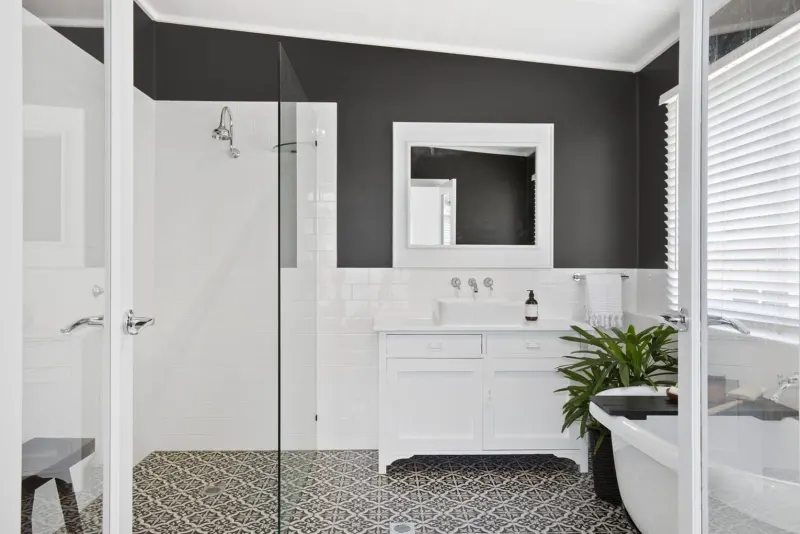
An accessible bathroom renovation gives the room a step-free shower, clear space around the toilet, a wider door and strong walls for grab rails. These are the bathroom features of the Livable Housing Design Standard, which the Queensland Government says has applied to new homes since 1 October 2023.
Some people call this a disabled bathroom remodel. Below is what each feature means, the published measurements, when a renovation has to follow the standard, how NDIS home modifications work, and the Queensland rules. Everything was checked on official pages on 12 October 2026. It is a short summary, not design or legal advice. For a person with a disability, an occupational therapist, your certifier and the official pages have the final word.
What makes a bathroom accessible?
Four things: you can get in without a step, you can get into the shower without a step or a hob, there is room to use the toilet, and the walls can take grab rails. The Queensland Government lists these features for new homes:
- step-free access into one bathroom and its shower
- an accessible toilet
- slightly wider internal doors and corridors
- reinforced bathroom and toilet walls, so handrails can be added later
The detail sits in the ABCB Livable Housing Design Standard, part of the National Construction Code 2022. It is written for older people and people with mobility limitations, and it is free to read.
A bathroom built for someone in a wheelchair may need more than this. Queensland's code lets some step-free access follow AS 1428.1, a separate Australian Standard. We do not quote its numbers here. If the bathroom is for one person's needs, start with an occupational therapist's advice, then plan the build around it.
What is a step-free shower?
A shower with no hob to step over and no step down into it. The Livable Housing Design Standard asks for at least one shower with a "hobless and step-free entry". It allows a lip of no more than 5 mm to hold water back.
The standard explains why it uses both words. A shower floor level with the bathroom floor is step-free, but could still have a hob. A shower with a step down has no hob, but is not step-free. You need both.
Water still has to stay in the shower. The standard points to AS 3740 and Part 10.2 of the NCC Housing Provisions, which both have rules for waterproofing a hobless, step-free shower. Queensland's own code adds cost-effective ways to meet the shower and floor-waste rules, such as a linear strip drain or weir at each entrance to the room.
Our guide to walk-in showers covers the pros and cons, and our bathroom waterproofing guide covers the licence rules and costs.
How much space does an accessible toilet need?
A clear space of at least 1200 mm by 900 mm in front of the toilet pan, under the Livable Housing Design Standard. That space must stay clear of the door swing, whether the door swings in, swings out or slides into the wall.
| Part of the room | Minimum in the standard |
|---|---|
| Clear space in front of the toilet pan | 1200 mm long by 900 mm wide |
| Separate toilet room, wall to wall either side of the pan | 900 mm clear |
| Basin or vanity, from the centre line of the pan | 450 mm |
| Door into the bathroom or toilet, clear opening | 820 mm |
| Hallway leading to that door | 1000 mm clear |
| Lip at the shower entry | 5 mm at most |
Source: ABCB Livable Housing Design Standard 2022, version 1.3 (November 2023). Skirting tiles, toilet roll holders and door stops can be ignored when you measure. For new homes, at least one toilet must be on the ground or entry level. Queensland makes an exception when that level has no habitable rooms.
How wide should an accessible bathroom door be?
At least 820 mm of clear opening, says the Livable Housing Design Standard. The standard notes that an 870 mm door leaf can generally give you that on a single swinging door.
Clear opening means the gap you can actually pass through with the door open, not the size of the door. The threshold matters too. It must be level, or have a lip of no more than 5 mm that is rounded or bevelled, or have a small ramp no steeper than 1 in 8 that stays within the depth of the door jamb.
The hallway outside counts as well. The standard asks for at least 1000 mm of clear width in a corridor that leads to one of these doors. Door handles may stick into that width.
Planning a cavity sliding door? If one sits next to the toilet, shower or bath, the standard warns it needs careful framing, so the wall can still hold a grab rail without stopping the door.
Where do grab rails go, and what goes in the wall?
Grab rails go beside the toilet, in the shower and beside the bath, and the wall behind them needs reinforcing so they hold. The Livable Housing Design Standard does not make you fit the rails straight away. It asks for walls that can take them later.
The reinforcing must be one of these, per the standard:
- structural grade plywood at least 12 mm thick, or similar
- timber noggings at least 25 mm thick
- light gauge steel noggings or metal plate, to the NASH Standard
Concrete or masonry walls that can hold a rail on their own need no extra reinforcing. A freestanding bath needs none either, when the room also has a step-free shower, because it has no wall to fix a rail to. The standard's drawings show the exact areas to reinforce around the toilet, shower and bath.
Reinforcing goes in while the wall frame is open. That is why Queensland does not expect it in a renovation where the framing stays covered (more on that below). The standard sets where the reinforcing goes, not where each rail is fixed.
Does a bathroom renovation have to meet the Livable Housing Design Standard in Queensland?
Usually not. The Queensland Government says the standard applies to new homes, with an exemption for renovations of less than half a house where it is not practical or reasonable to comply. Repairs and maintenance generally do not trigger it.
The Queensland Government's page on the Modern Homes standards adds that bathroom and toilet renovations do not need wall reinforcing where it is not reasonable or practical, for example where the wall framing is not exposed. Since 14 August 2026, Queensland's code also gives "greater flexibility in accessible bathroom design". If your job needs building approval, your certifier decides what applies.
Not required is not the same as not worth it. The Queensland Government, quoting a national impact study, puts the average cost of retrofitting a home to the standard at around $20,000. For a new home, the same features can cost as little as 1% of the build.
Will the NDIS pay for an accessible bathroom?
It can, for an NDIS participant, when the change relates to their disability and meets the NDIS rules. The NDIS gives "modifying a bathroom" as an example of a complex home modification. It only funds work on a home you own, or a home whose owner agrees to the changes.
| NDIS type | What it is | Cost, as the NDIS describes it |
|---|---|---|
| Simple home adaption | Changes that make the home safer and easier to move around | Less than $1,500 each, usually funded as low-cost assistive technology |
| Minor home modification | Straightforward, does not affect the structure, for example adding or removing taps | Generally less than $25,000 in total |
| Complex home modification | Affects the structure or needs custom or technical work, with approvals and certificates | Generally more than $25,000 in total |
Source: NDIS, what are home modifications (July 2026) and its guide to home modifications (July 2026). These are the NDIS's own categories, not a promise of funding.
For minor and complex work, a home modification assessor (an occupational therapist with extra training) recommends the changes. The NDIS only pays for work done by qualified tradespeople. It does not generally fund cosmetic finishes such as tiles or tapware that are not needed for the modification. Talk to your my NDIS contact before you book any work.
What Queensland rules apply to an accessible bathroom renovation?
The same rules as any bathroom renovation. Building work over $3,300 must be done by a contractor with a QBCC licence, and plumbing and drainage need a licence at any value.
- Moving the toilet or shower is notifiable plumbing work. The plumber registers it with the QBCC and gives the owner, or whoever hired them, a copy.
- Electrical work, such as moving a power point, needs a licensed electrician. The Electrical Safety Office says DIY electrical work is illegal.
- Work over $3,300 needs a written contract and home warranty insurance. The most a contractor can ask as a deposit is 10% for jobs from $3,301 to $19,999, and 5% for jobs of $20,000 or more.
Our bathroom renovation cost guide has published price ranges for the rest of the job.
We renovate bathrooms across the Gold Coast, from the strip-out and framing to the fit-off. If you want grab rails now or later, tell us at the start, so the reinforcing goes in while the walls are open. We book and run the trades, with licensed plumbers and electricians doing their parts, and you get a timeline with your proposal. See our bathroom renovations page for how we run a job.
Where does this information come from?
Checked on 12 October 2026: the ABCB Livable Housing Design Standard 2022, version 1.3 (November 2023); the Queensland Government's pages on building accessible housing (March 2025), the Livable Housing Design Standard (undated, mentions changes from 14 August 2026) and the Modern Homes standards (undated); the NDIS (what are home modifications, July 2026; guide to home modifications, July 2026; home modification assessors, August 2026); and the QBCC (when you need a licence, August 2021; notifiable work, February 2024; contract types and deposits, June 2025; home warranty, May 2025), plus the Electrical Safety Office (DIY electrical work, undated). We will check these rules again every three months.
See our bathroom renovations work, or check what your job will cost.