 Brett Field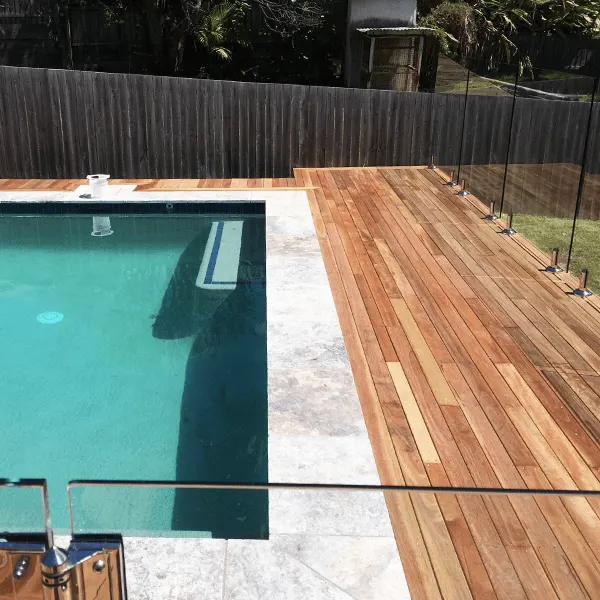
For a timber pool deck, use a hardwood rated Class 1 above ground, such as spotted gum or blackbutt, or H3 treated pine, with fixings made for wet, corrosive spots. In Queensland, the deck must also keep the pool fence safe: the QBCC wants the fence at least 1,200 mm high, with nothing climbable within 900 mm of its outside.
Below is which timber suits a pool deck, how it compares with composite, what it costs, and the Queensland pool fence and approval rules a deck has to meet. These are market prices from cost guides, checked on 12 October 2026. They are not a quote from us.
Which timber should I use for a pool deck?
A hardwood rated Class 1 above ground, such as spotted gum or blackbutt, is the safe pick, with H3 treated pine as the cheaper choice. Timber Queensland's data sheet on residential decks says boards and framing above ground should be cypress, H3 treated pine or Class 1 hardwood, and any hardwood sapwood must be treated.
Here is how the two main hardwoods compare, from the Queensland Government's timber data:
- Spotted gum. Class 1 above ground, which means a life of more than 40 years. Termite resistant. Very hard, rated 1 on a six-step scale, so it dents less.
- Blackbutt. Also Class 1 above ground and termite resistant. Rated hard, one step down. Its sapwood is not attacked by lyctid borers, while untreated spotted gum sapwood can be.
Treated pine is the cheapest board on the Gold Coast (see the prices below). One thing to check: Timber Queensland says CCA treated timber should not be used for home decking boards. For merbau, ironbark, tallowwood and the bushfire rating of each, see our decking timber guide for the Gold Coast.
Is composite better than timber around a pool?
Often, yes, and it is fair to say so. What's The Damage's Gold Coast guide picks composite for most pool surrounds, because of the constant wet, the chlorine or salt, and bare feet on it all summer. Composite needs a wash, not oil or sanding.
It has two catches:
- Heat. Dark composite boards get much hotter underfoot in full sun than timber. What's The Damage says a north or west-facing deck in January can be hard to use barefoot, so choose a light colour, or add shade.
- Repairs. A gouged hardwood board can be sanded. A damaged composite board has to be replaced, and matching it years later is often not possible because ranges change.
Timber's catch is upkeep. What's The Damage says a Gold Coast deck in full sun needs sanding and oiling every 12 to 24 months. Hardwood left unoiled turns silver grey but stays sound, so if you like that look, the upkeep mostly goes away. Either way, the frame underneath is usually timber, so termites still matter with composite boards on top.
How much does a pool deck cost on the Gold Coast?
A timber deck on the Gold Coast costs about $175 to $610 per m2, built and finished, depending on the timber, according to What's The Damage (Gold Coast page). It does not price pool decks on their own, so these are its general 2026 deck prices.
| Deck board, per m2 built (What's The Damage, Gold Coast page, 2026) | Low | Typical | High |
|---|---|---|---|
| Treated pine | $175 | $255 | $345 |
| Merbau | $295 | $410 | $540 |
| Blackbutt | $325 | $440 | $610 |
| Spotted gum | $345 | $470 | $590 |
| Composite | $275 | $540 | $685 |
| Composite, premium capped or solid-core | $440 | $560 | $880 |
The same page puts a 25 m2 hardwood deck at $7,850 to $15,700 in total. Steps and railings add to that. It prices deck steps at $175 to $390 each and a balustrade at $145 to $440 per metre.
How does the pool fence rule affect a deck?
A deck must never give a child a way over the pool fence. The QBCC's pool fence rules say the fence must be at least 1,200 mm high, with a gap of no more than 100 mm at the bottom, measured from the finished ground level or the stable surface under it.
That affects a deck in three ways:
- The deck can make the fence too short. Height is measured from the ground or stable surface under the fence, so a deck built up against it can cut the height. Check the fence is still 1,200 mm above the boards.
- Keep a clear zone. The QBCC lists deck ledges, steps and stairs as climbable objects. For a fence under 1,800 mm high, they must be at least 900 mm from the outside of the fence and 300 mm from the inside.
- Take care at steps. At stairs, the 1,200 mm is measured straight up from the edge of each tread. The QBCC says gaps over 100 mm under glass panels at stairways are a common problem.
If you cannot keep the outside zone clear, the QBCC allows a fence at least 1,800 mm high with a 900 mm clear zone on the inside, measured down from the top. The inside height must stay at 1,800 mm, with nothing at the bottom, "such as a deck", reducing it. Read its page on non-climbable zones before you draw the deck. A certifier or pool safety inspector has the final word on your fence.
Can a deck or balcony be part of the pool fence?
Yes, but then it has to meet the pool fence rules. The QBCC says that if a balcony is over the pool fence or within 900 mm of it, its balustrade must meet the pool fence standard, not just the normal balustrade rules.
Two more rules catch people out:
- One side stays open. A deck, patio, pergola or balcony that forms part of the fence, or sits inside the pool area, must have one complete side permanently open. No blinds, insect screens or shade cloth on that side, so you can always see the pool.
- Above-ground pools. The sides of an above-ground pool can act as the fence if they are at least 1,200 mm high and cannot be climbed from outside. But the QBCC says the way in, such as a ladder, must be surrounded by a permanent fence and gate. A deck built up to the pool often becomes that way in.
For the height and gap rules on ordinary deck balustrades, see our guide to balustrade height rules in Queensland. The QBCC page on doors, windows and balconies near pools has the full list.
Does a pool deck need council approval on the Gold Coast?
Usually, yes. The City of Gold Coast says a new timber deck is likely to need building approval from a private certifier. A raised deck is exempt only if it is under 10 m2, less than 1.0 m high and meets all building requirements.
The pool fence adds a second trigger. The City says a fence up to 2.0 m high usually needs no approval, but new swimming pool fencing of any height is an exception. So if the deck job includes new pool fencing, that part needs approval too.
The work needs a licence as well. In Queensland, building work over $3,300 must be done by a QBCC licensed contractor, and What's The Damage notes that even the low end of its small-deck range, $4,900, is above that. Our guide to council approval for renovations on the Gold Coast covers decks, pergolas and patios in more detail. A certifier has the final word for your site.
How do I stop a pool deck getting slippery or rotting?
Help it dry, keep it clean, and use the right boards and fixings. The Queensland Government's deck advice is to sweep instead of hosing where you can, not let water sit, and make sure a wet deck has enough air flow to dry quickly.
- Choose narrow boards. Timber Queensland recommends them because they shed water more readily, so they are less likely to cup and twist.
- Think twice about ribbed boards. Reeded or ribbed boards can be laid ribbed side up as a "non-slip" surface. Timber Queensland warns they then need regular cleaning, because dirt and mould in the grooves can make them more slippery and speed up decay.
- Leave the right gaps. Timber Queensland's minimum is 3 mm for hardwood boards up to 90 mm wide, and 5 mm for softwood. Our guide to decking board spacing covers composite gaps too.
- Use tougher fixings. Timber Queensland lists swimming pools, like the coast, as corrosive spots that need a higher level of protection on fixings. Our decking timber guide (linked above) covers which screws and brackets to use.
Near the beach, the Queensland Government also suggests oil-based paint on the bearers, joists and posts, because decking oil alone may not be enough against the coastal weather.
We build timber and composite decks across the Gold Coast, including pool decks, deck stairs and landings, and balustrades in timber or stainless wire. We book and run the trades, and you get a timeline with the proposal. See our deck building page.
Where does this information come from?
Checked on 12 October 2026: the QBCC (pool fences, May 2025; non-climbable zones, reviewed May 2025; doors, windows and balconies, May 2025; when you need a licence, August 2021), the City of Gold Coast (do your building works need approval, no date shown), Timber Queensland (Technical Data Sheet 4, Residential Timber Decks, March 2014), the Queensland Government's timber properties pages for spotted gum (May 2021) and blackbutt (December 2018), the Queensland Government's deck maintenance page (November 2019), and What's The Damage (Gold Coast decking page and composite vs timber page, October 2026). We will check the prices again every three months.
See our decks and patios work, or check what your job will cost.