 Brett Field
A mudroom is a small room at the back door, or at the door in from the garage, where you take off dirty shoes, wet coats and bags before you walk into the rest of the house. Architecture & Design describes it as a room that works like a lobby between the back door and the living areas.
You do not need a whole spare room to get one. Below is what a mudroom is for, how it differs from an entry or a laundry, who it suits, how to add one to an existing home, what joinery goes in it, the sizes we could check, and the Queensland rules. The sizes come from a design guide and a wardrobe maker, checked on 18 October 2026.
What is a mudroom used for?
It keeps the mess at the door so the rest of the house stays clean. Architecture & Design's guide says its main job is to stop people tracking mud or water through the house. It gives you a place to take off and store dirty shoes, coats, gloves and umbrellas.
Most mudrooms hold some mix of:
- a bench to sit on while you take your shoes off
- hooks for coats, bags and hats
- shelves or cubbies for shoes
- cupboards or lockers, often one per person
- somewhere for towels, wipes and cleaning gear
Where does a mudroom go in a house?
Usually at the back door, or at the inside door from the garage. Architecture & Design gives two reasons. It is the door the family uses in wet weather, and it keeps the mess out of view for guests coming in the front.
That location is the main difference between a mudroom and an entry or foyer. Here is how the three spaces compare.
| Space | Where it is | Main job |
|---|---|---|
| Entry or foyer | The front door | Where guests come in |
| Mudroom | The back door or the garage door | Where the family drops shoes, bags and wet gear |
| Laundry | Wherever the tub and washing machine are | Washing clothes |
Source: Architecture & Design, "The mud room: where is it and what is it used for?", checked 18 October 2026.
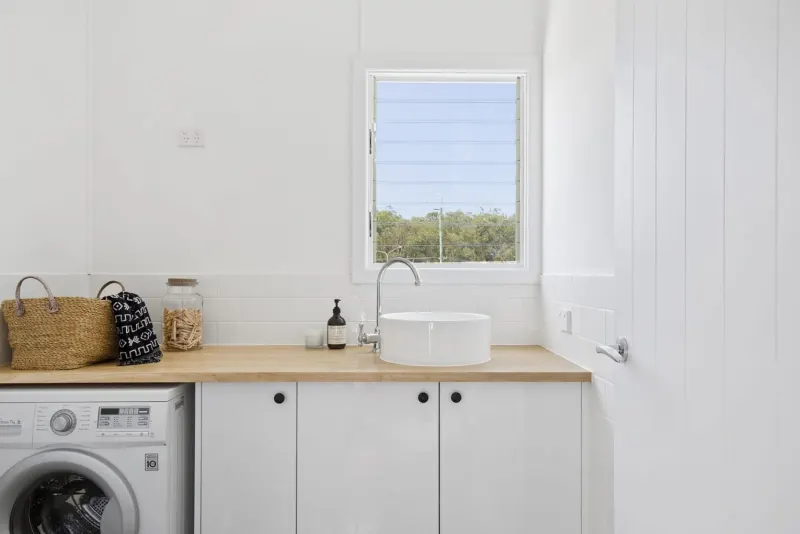
The lines can blur. The same guide says some mudrooms also have laundry facilities, so dirty clothes can go straight into the wash. If your laundry is already at the back door, it may be the easiest room to turn into a mudroom.
Do I need a mudroom?
You do not need one, but it earns its space in some homes more than others.
It tends to suit you if:
- the family comes and goes through the garage or back door, not the front
- you have school bags, sports gear and shoes piling up near the door
- you have a pool or live near the beach, so wet towels and sand come inside
- you have a dog that needs a wipe down before it comes in
It is harder to justify if there is no room near the back door, or if everyone comes in the front. In that case, a short run of hooks, a bench and shoe shelves in a hallway can do most of the job. Architecture & Design calls that an "effective (albeit narrow) mudroom space".
How do you add a mudroom to an existing home?
There are three ways, from least work to most. Architecture & Design says some families choose to repurpose an existing room rather than renovate.
- Fit out a wall or hallway. Hooks, a bench, shoe shelves and a tall cupboard on one wall near the back door. No walls move.
- Convert a room you already have. Part of the laundry, a spare room, or a wide hall by the garage door gets cupboards, a bench and hooks.
- Build new floor space. A small extension at the back door. This usually needs building approval, plans and more trades.
The first two are mostly joinery: cupboards, benches and shelves made to fit the space. The third is a bigger job. If a wall has to come out to make room, check first whether it is load-bearing. The Queensland rules section below explains when approval is needed.
What should go in a mudroom?
Start with a list of who uses the door and what they carry. Architecture & Design's list of mudroom ideas includes:
- Seating. A proper seat means people take boots off carefully instead of pushing them off standing up, so less dirt splashes around.
- Strong hooks. They need to hold heavy, wet coats and bags. Have enough for everyone, or wet clothes hang too close together to dry.
- Storage. One idea from the guide: half the cupboards for cleaning gear and clean clothes, the rest for drying wet clothes before they go in the wash.
- Supplies. Wipes for boots, towels and spare slippers.
- Tall cupboards. Vertical shelving and cupboards make a small room feel taller.
Plan any power points early, for charging phones or running a dryer. The rules section below covers who can install them.
How big should mudroom cupboards and shoe shelves be?
We did not find a checked Australian page that sets mudroom sizes. A mudroom stores the same coats and shoes as a wardrobe, so these figures come from Houzz's wardrobe guides and IKEA's wardrobe frames.
| Part | Size | Source |
|---|---|---|
| Cupboard for coats on hangers | About 600-650 mm deep, including doors | Houzz (2023) |
| Tall cupboard frame, full depth | 580 mm deep, about 500, 750 or 1,000 mm wide | IKEA PAX |
| Tall cupboard frame, slim | 355 mm deep | IKEA PAX |
| Shelves for folded clothes | 380 mm deep | Houzz (2017) |
| Shelves for shoes | 300-380 mm deep | Houzz (2017) |
| Shoe pigeon hole | 220-300 mm wide, at least 350 mm deep (a little more for men's shoes) | Houzz (2023) |
| Height between shoe shelves | 220-260 mm, about double for boots | Houzz (2023) |
Source: Houzz ("An Insider's Guide to Walk-In Wardrobe Measurements", 2023, and "Expert Eye: How to Squeeze in a Walk-In Wardrobe", 2017) and IKEA Australia PAX product pages, checked 18 October 2026.
The slim depth is handy in a hallway. If coats go on hooks rather than hangers, a shallow cupboard can work and leave more room to walk past. Our guide to standard wardrobe depth explains these sizes in more detail. We found no checked figure for hook or bench height, so set those to suit your family, with a lower row of hooks for kids.
How much does a mudroom cost?
There is no set price. A mudroom fit-out is priced like any other built-in joinery: the cupboards and shelves, the bench, the hooks and the install. Add the plumber or electrician if it gets a tub or power points, and much more if it needs an extension.
Built-in cupboards are usually priced per linear metre of wall. Our guide to built-in wardrobe costs has prices for flat pack, modular and made-to-measure robes and per-metre rates, so you can price a run of mudroom cupboards the same way. Our guide to the butler's pantry covers a similar small room, including what a sink and power points add.
Ask for each part as its own line on the quote: joinery, benchtop, plumbing, power and any building work.
What Queensland rules apply to a mudroom?
The rules matter most once a mudroom gets plumbing, power or new floor space. This is a short summary, not legal advice.
- Licence. Building work valued over $3,300 needs a contractor with a QBCC licence. Under that, a handyman can do it, as long as it is not electrical or plumbing work. The QBCC's carpentry licence covers installing "fitments", and its cabinet making licence covers installing fitted cabinets on site.
- A tub or sink. Plumbing and drainage need a QBCC licence at any value. In an existing home, the QBCC's examples of notifiable work include installing new fixtures such as basins and kitchen sinks. The plumber registers that work with the QBCC within 10 business days of invoicing it.
- Power points. Queensland's Electrical Safety Office says installing a new power point is work for a licensed electrician.
- Approval. Under Schedule 1 of the Building Regulation 2021, alterations to an existing house do not need building approval unless they change the floor area or height, affect a structural part (apart from minor ones), or affect the fire safety system. So fitting out a hallway or a room is usually fine. An extension, or taking out a load-bearing wall, is not. A building certifier has the final word for your home.
- Deposit. The most a contractor can ask is 10% for work of $3,301 to $19,999, and 5% for work over $20,000. The QBCC allows up to 20% when made-to-measure work built off site is more than half the contract price.
What is different for a mudroom on the Gold Coast?
Here the mess at the back door is often sand, wet towels and swimmers, and the air is humid. Both are hard on cupboards.
We found no Gold Coast guide on this, so the nearest is Sparky's Brisbane kitchen cabinet guide (updated September 2026). It says standard particleboard will swell at the joins within 2 to 3 years in Brisbane's humidity, and that HMR (high moisture resistant) board is the minimum for cabinet boxes. A mudroom full of damp gear is the same test, so ask what the cupboards are made of.
Near the beach, the hardware matters too. What's The Damage's Gold Coast kitchen page says coastal suburbs need stainless or marine-grade fittings, and that standard chrome finishes will pit within 18 to 24 months. That goes for the hooks and handles in a mudroom.
We build built-in cupboards, bench seats and laundry fit-outs across the Gold Coast, made to fit the space, and we book the licensed plumber and electrician when a job needs them. See our carpentry work, or our laundry renovations if the mudroom is part of the laundry.
Where does this information come from?
Checked on 18 October 2026: Architecture & Design ("The mud room: where is it and what is it used for?", first published December 2022); Houzz ("An Insider's Guide to Walk-In Wardrobe Measurements", 17 July 2023, and "Expert Eye: How to Squeeze in a Walk-In Wardrobe", 17 May 2017); IKEA Australia PAX wardrobe frame product pages (no date shown); Sparky (kitchen cabinetry cost, Brisbane, updated September 2026); What's The Damage (kitchen renovation cost, Gold Coast page, verified October 2026). Rules from the QBCC (when you need a licence, last reviewed 11 August 2021; carpentry and cabinet making licence scopes, 30 August 2021; notifiable work, 14 February 2024; deposits and progress payments, 27 June 2025), the Electrical Safety Office (no date shown) and the Building Regulation 2021 (Qld). We will check these again every three months.
See our carpentry work, or check what your job will cost.