 Brett Field
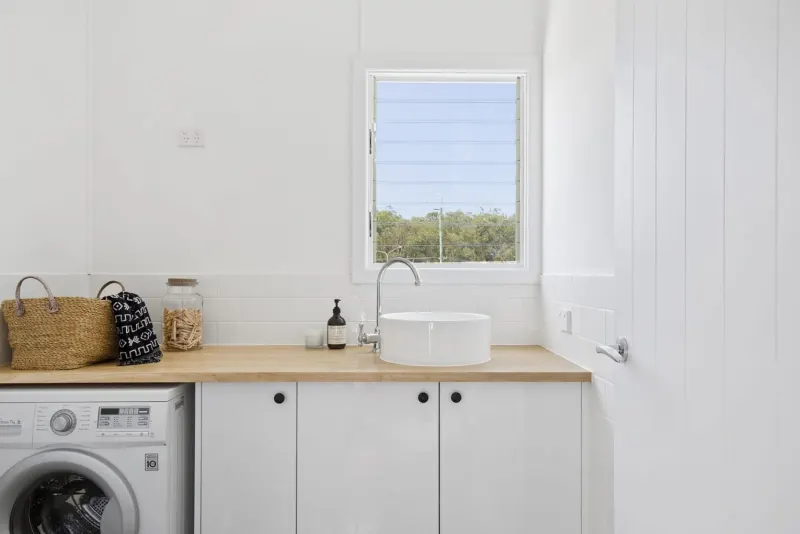
A European laundry is a full laundry built into a cupboard, so it hides behind doors when you are not using it. If it is your home's only laundry, the National Construction Code 2022 (NCC), which Queensland builds to, says it needs a washtub as well as space for the washing machine.
Below is what a European laundry is, where it can go, its pros and cons, and the Queensland rules that shape it. The rules come from the NCC and Queensland Government pages, checked on 18 October 2026. There are no prices here: our laundry renovation cost guide has published price ranges. This is a short summary, not legal advice.
What is a European laundry?
A European laundry, or Euro laundry, is a laundry fitted into a cupboard or a run of joinery instead of a room of its own. Close the doors and it looks like any other cupboard.
Kaboodle, a kitchen cabinet maker, names three common spots for one:
- The kitchen. Under the benchtop, inside a butler's pantry, or behind full-height cupboards.
- The bathroom. It is already a wet area, so the room is built to handle water.
- The hallway. Next to the linen cupboard, so washing goes from the machine to the shelf.
Most European laundries are built around a front-loading washing machine. Kaboodle says a front loader suits a small laundry because it fits under a benchtop or stacks with a dryer. The rest is a tub, taps, a benchtop and some shelves or cupboards, all sized to the space you have.
What are the pros of a European laundry?
The main pro is space. You get a working laundry without giving up a whole room for it.
- It frees up a room. The floor a laundry room would take can go to a study, a bigger kitchen or more storage.
- It hides away. With the doors shut, guests see joinery, not a washing machine.
- Washing happens where it is made. Kaboodle points out that tea towels can go straight in from the kitchen, and clothes from bath time can go straight in from the bathroom.
- It can share a room. Kaboodle pairs a European laundry with a home office or a storage wall, so one space does two jobs.
It also suits homes where the old laundry is being taken over for something else, like a bigger kitchen or an extra bathroom.
What are the cons of a European laundry?
The main cons are less room to work, noise and damp air close to living areas, and less room to change things later.
- Less bench space. A cupboard has far less room than a laundry for sorting, folding and parking a basket.
- Nowhere to dry clothes. There is no space inside to hang anything.
- Noise. In a kitchen or hallway, you hear the spin cycle.
- Damp air. A clothes dryer in a closed cupboard needs a plan for its air. The rules for this are below.
- The tub still needs room. If it is your only laundry, the NCC says a kitchen sink does not count as the washtub.
- Fixed sizes. The cupboard is built around your machines. A bigger washer later may not fit.
What does the building code say a laundry must have?
A washtub and space for a washing machine, in the same room. NCC 2022 Housing Provisions Part 10.4 says a house must have clothes washing facilities: "at least one washtub and space in the same room for a washing machine".
The NCC's notes add that a kitchen sink or a basin must not be counted as a laundry washtub. So a European laundry in a kitchen still needs its own tub if there is no other laundry in the house.
Does a cupboard count as "the same room"? The NCC parts we checked do not say. Your certifier, the person who checks building work against the code, has the final word, so ask before the cupboards are made.
Queensland still builds to the NCC 2022. Business Queensland says the NCC 2025 will not start in Queensland until 1 May 2027.
Does a European laundry need waterproofing in Queensland?
Yes. The NCC counts a laundry as a wet area, and Part 10.2 sets what must be water resistant or waterproof in one. In short: the laundry floor and the joins between the walls and floor must be water resistant, the wall behind a tub that sits close to it must be water resistant above the tub, and tap holes must be waterproof. Our laundry cost guide, linked above, lists each rule with its measurements.
A European laundry raises a question those rules do not answer on their own. The NCC's definition of a wet area includes laundries but leaves out kitchens. When the laundry is a cupboard inside a kitchen or hallway, ask your certifier and waterproofer at the design stage which floor and walls the rules cover.
Floor drains matter too. The Queensland Government says the NCC 2022 requires wet area floors, such as laundries, to be graded to a floor waste where one is installed. Queensland's own code adds other options, like a strip drain or a weir at each entrance to the room.
Waterproofing is its own QBCC licence class. Our guide to bathroom waterproofing cost in Queensland covers who can do it.
Does a European laundry need a vent or exhaust fan?
It needs fresh air, and a venting clothes dryer must be ducted outside. Under NCC 2022 Part 10.6, a laundry needs a window, door or other opening of at least 5% of the room's floor area, opening to the outside or, in some cases, to the next room. An exhaust fan can be used instead.
If there is a fan, NCC Part 10.8 says:
- a laundry exhaust fan must move at least 40 litres of air a second
- it must vent to the outside air, directly or through a duct
- a venting clothes dryer must also discharge outside, directly or through a duct
The NCC notes that the dryer rule applies only to venting dryers, not to other types such as condensing dryers. A laundry cupboard with no window is where these rules matter most, so settle the dryer type and the fan before the joinery is drawn up.
A licensed electrician has to wire any fan or new power point. The Electrical Safety Office says: "Always get a licensed electrician to do any electrical work."
Who can build a European laundry in Queensland?
It takes a few trades. Building work over $3,300 needs a contractor with a QBCC licence, and plumbing needs a licence at any value.
| Part of the job | Who does it | The rule |
|---|---|---|
| Cupboards, benchtop, shelves and doors | A carpenter | QBCC licence for building work over $3,300 |
| Water and waste pipes, and the tub | A licensed plumber | QBCC licence at any value |
| Exhaust fan and power points | A licensed electrician | Electrical Safety Office: a licensed electrician for any electrical work |
| Waterproofing | A licensed waterproofer | Waterproofing is its own QBCC licence class |
Source: QBCC (when you need a licence; waterproofing licence class) and the Electrical Safety Office, checked 18 October 2026.
Putting in new fixtures or moving them is often notifiable work. The QBCC says the plumber must register notifiable work with it within 10 business days of invoicing the job.
Is a European laundry right for my home?
It suits a home that is short on space and can live with a smaller work area. Run through these before you decide:
- Where will it go? Close to the existing water and waste pipes is cheaper. Moving plumbing is the biggest jump in a laundry budget, as our cost guide shows.
- Is there room for a tub? If it is your only laundry, plan for one next to the machine.
- Washer only, or a dryer too? A venting dryer needs a duct to the outside.
- How will it get fresh air? A window nearby, or an exhaust fan that vents outside.
- Where will you fold? A benchtop over the machines helps.
- Does it need approval? Our guide to council approval for renovations covers internal work and plumbing.
We do laundry renovations and laundry fit-outs on the Gold Coast. Brett makes the cupboards, the benchtop over the washer and dryer, and the shelving to fit your space, and books licensed trades for the plumbing, electrical and waterproofing. You get a timeline with your proposal. See our laundry renovations page.
Where does this information come from?
Checked on 18 October 2026: the National Construction Code 2022 Housing Provisions from the Australian Building Codes Board, Part 10.4 (clause 10.4.1), Part 10.2 (clauses 10.2.1 and 10.2.5), Part 10.6 (clause 10.6.2), Part 10.8 (clause 10.8.2) and the glossary (no page dates shown); Business Queensland, delayed adoption of the NCC 2025 (updated 14 September 2026); the Queensland Government's page on the Modern Homes standards (undated); the QBCC pages on notifiable work (February 2024), when you need a licence (August 2021) and the waterproofing licence class (August 2021); the Electrical Safety Office, don't do your own electrical work (undated); and Kaboodle, maximising space with a European laundry (undated). We will check these rules again every three months.
See our carpentry work, or check what your job will cost.