 Brett Field
Most timber decks in Australia have joists at 450 mm centres. Timber Queensland's residential deck sheet sets 450 mm as the maximum, and the AS 1684 table published by WoodSolutions lets 19 mm hardwood boards span up to 500 mm. Composite boards follow each maker's own guide, mostly 400 to 450 mm.
Below is a joist spacing chart for timber and composite boards, the difference between joist spacing, joist span and bearer span, what changes for diagonal boards and busy decks, and the Queensland rules. These are published figures from Timber Queensland, WoodSolutions and the board makers, checked on 5 October 2026. They are a guide, not a design for your deck.
What is the maximum joist spacing for timber decking?
It depends on the board's thickness and the timber. A thicker, stiffer board can span further between joists. Here is what the Australian sources publish.
| Decking board | Thickness | Maximum joist spacing | Source |
|---|---|---|---|
| Hardwood, standard grade | 19 mm | 500 mm | Timber Queensland; AS 1684 via WoodSolutions |
| Hardwood, standard grade | 25 mm | 650 mm | Timber Queensland |
| Cypress | 19 mm | 400 mm | AS 1684 via WoodSolutions |
| Cypress | 21 mm | 450 mm | Timber Queensland; AS 1684 via WoodSolutions |
| Treated pine (H3) | 19 mm | 400 mm | AS 1684 via WoodSolutions |
| Treated pine (H3) | 22 mm | 450 mm | Timber Queensland; AS 1684 via WoodSolutions |
Those are the most the boards can span. Timber Queensland's residential deck sheet still fixes joists no more than 450 mm apart, and its joist span table is built on that spacing. The Australasian Timber Flooring Association (ATFA) adds that more flexible boards, such as pine, may suit closer joists, and thicker boards may allow wider ones.
All of these figures are for boards laid square across the joists on a normal home deck. You can read the AS 1684 table in the WoodSolutions guide to domestic timber deck design. Diagonal boards and busy decks need closer joists, as covered below.
What joist spacing do composite decking boards need?
Composite boards are not in the AS 1684 table, so each maker publishes its own limit. ModWood and Trex both say that not following their instructions can void the warranty. Here is what four brands sold in Australia say.
| Brand and board | Home deck | Commercial or heavier use | Guide date |
|---|---|---|---|
| ModWood 88 x 23 mm | 450 mm | Not suitable for commercial use | September 2021 |
| ModWood 137 x 23 mm (including Flame Shield and Xtreme Guard) | 450 mm | Suitable, but may need closer joists for heavy point loads | 2020 to January 2026 |
| ModWood 137 x 32 mm | 600 mm | Suitable, as above | September 2021 |
| Ekodeck Classic and Designer Series | 450 mm | 400 mm (also for stairs and landings) | 2025 |
| Trex 25 mm boards and 22 mm Select | 406 mm (16 inches) | 406 mm, or 305 mm (12 inches) for the heaviest loads | 2024 |
| Millboard | 400 mm | 300 mm for heavy commercial use, bridges, balconies, moorings and steps | June 2022 |
ModWood says its 450 mm figure "may be reduced" depending on the load, and to ask them for a deflection calculation. Its installation page has the fixing sheet for each board. Trex writes its guide in inches, so 16 inches on centre is the 406 mm in the table.
What is the difference between joist spacing, joist span and bearer span?
They are three different distances in the frame, and each one has its own table.
- Joist spacing is the distance from the centre of one joist to the centre of the next. It is how far each decking board spans. Makers call it "joist centres" or "on centre". The charts above are about this one.
- Joist span is how far a joist runs between its supports, which are the bearers or a ledger fixed to the house. It depends on the joist's size, its stress grade and the joist spacing.
- Bearer span is how far a bearer runs between posts or stumps. It depends on the bearer's size and grade, and on how long the joists it carries are.
Here is Timber Queensland's joist span table for joists at 450 mm spacing on a home deck with timber boards. "Continuous" means one joist runs unbroken over two or more spans.
| Joist (Timber Queensland, 2014) | Single span | Continuous span |
|---|---|---|
| Treated pine F7, 90 x 45 mm | 1,300 mm | 1,700 mm |
| Treated pine F7, 120 x 45 mm | 2,200 mm | 2,200 mm |
| Treated pine F7, 140 x 45 mm | 2,600 mm | 2,600 mm |
| Treated pine F7, 190 x 45 mm | 3,600 mm | 3,600 mm |
| Treated pine F7, 240 x 45 mm | 4,500 mm | 4,500 mm |
| Unseasoned hardwood F14, 100 x 50 mm | 2,200 mm | 2,500 mm |
| Unseasoned hardwood F14, 125 x 50 mm | 2,800 mm | 3,200 mm |
| Unseasoned hardwood F14, 150 x 50 mm | 3,400 mm | 3,800 mm |
| Unseasoned hardwood F14, 175 x 50 mm | 3,900 mm | 4,500 mm |
| Unseasoned hardwood F14, 200 x 50 mm | 4,400 mm | 5,100 mm |
Hyne's deck joist table gives the same 2,600 mm single span for a 140 x 45 mm joist (its T3 Green MGP10) at 450 mm spacing.
Bearers work the same way. In Timber Queensland's table, a double 140 x 45 mm treated pine bearer can span 2,000 mm when it carries joists 1.8 m long, but only 1,700 mm when they are 2.4 m long. Bearer span decides how many posts and footings the deck needs, which our guide to deck footings covers.
Timber Queensland's tables assume decking that weighs no more than 20 kg per m2. WoodSolutions says the AS 1684 sizes do not apply to a tiled deck, or one with a spa or hot tub. Those need a structural engineer.
How close do joists need to be for diagonal decking?
Closer than for square boards. WoodSolutions gives this example: 19 mm hardwood boards laid at 45 degrees need joists at 350 mm, to keep the board span within its 500 mm limit.
The reason is simple geometry. A board at 45 degrees crosses each joist on a slant, so the length of board between two joists is about 1.4 times the joist spacing. At 350 mm spacing that is about 495 mm of board, just inside the limit. At 450 mm it would be about 636 mm, which is too far. The same goes for herringbone and chevron patterns: WoodSolutions says any board not square to the joists must still stay within the table.
The composite makers give their own numbers:
- Trex: at 45 degrees, 4 inches (102 mm) less than the normal spacing, so about 305 mm on a home deck. At 30 degrees, half the normal spacing.
- Millboard: at 45 degrees, no more than 300 mm, or 240 mm for commercial use.
Do commercial decks, stairs and pool decks need closer joists?
Commercial decks and stairs often do. A pool deck at home mostly changes the fixings, not the spacing.
- Commercial. Ekodeck drops from 450 mm to 400 mm. Millboard drops to 300 mm for heavy commercial use. Trex drops to 305 mm for its heaviest load. ModWood says its 88 mm board is not for commercial use at all. Timber Queensland's commercial data sheet uses much thicker boards, 35 to 45 mm, with spans set by the load.
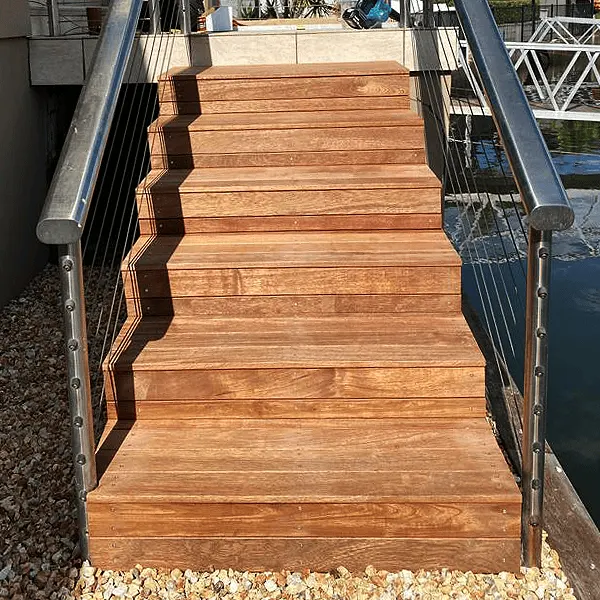
- Stairs and landings. Ekodeck asks for 400 mm. Millboard asks for 300 mm on steps.
- Pool decks. None of the guides we read asks for closer joists beside a home pool. What changes is the fixings: WoodSolutions says fixings within 1 m of a pool edge must be stainless steel. Our decking timber guide covers fixings near pools and the beach.
For any commercial deck, WoodSolutions says a structural engineer must be consulted.
How many joists does my deck need?
Measure the deck along the way the boards run. Divide that by the joist spacing, round up, then add one for the end joist.
Say your deck is 6 m long, with the boards running the long way and joists at 450 mm. 6,000 ÷ 450 = 13.3, which rounds up to 14 gaps, so 15 joists. At 400 mm it is 6,000 ÷ 400 = 15 gaps, so 16 joists. Going closer costs one extra joist on this deck.
Some composite makers need more. Millboard wants a double joist or blocking wherever two board ends meet.
What is different in Queensland?
Composite boards need extra paperwork. The QBCC says no Australian Standard for wood plastic composite decking is referenced in the National Construction Code's standard (deemed-to-satisfy) rules. So the board needs a performance solution, unless it holds a current CodeMark certificate, which means that work has already been done. The QBCC's fact sheet on composite decking boards also says designs using them should have the loads worked out by a Registered Professional Engineer of Queensland (RPEQ).
So before you buy composite boards, ask the supplier for the CodeMark certificate and the install guide, and pass both to your certifier. Timber decks have the AS 1684 tables behind them. Either way, the published table is a starting point: your certifier or engineer has the final word on the frame for your site. Whether your deck needs building approval is covered in our guide to council approval on the Gold Coast.
We build timber and composite decks across the Gold Coast, including pool decks, deck stairs and landings. You get a timeline with the proposal, before any work starts. See our deck building page for what we build.
Where do these figures come from?
Checked on 5 October 2026: Timber Queensland Technical Data Sheet 4, Residential Timber Decks, and Data Sheet 7, Commercial, Industrial and Marine (both revised March 2014); WoodSolutions Technical Design Guide 21, Domestic Timber Deck Design (revised October 2020), which reproduces the AS 1684 decking table; ATFA's Residential Timber Decks (April 2020); Hyne Timber's deck joist span table (version 4, undated); ModWood fixing instructions (September 2020, September 2021 and January 2026); Ekodeck's Classic and Designer Series installation pages (2025); the Trex 2024 Decking Installation Guide; the Millboard installation guide (June 2022 edition, from Australian supplier Modinex); and the QBCC fact sheet on wood plastic composite decking boards (effective May 2023, version 5). The 45 degree and joist count sums are ours. We will check the figures again every three months.
See our decks and patios work, or check what your job will cost.