 Brett Field
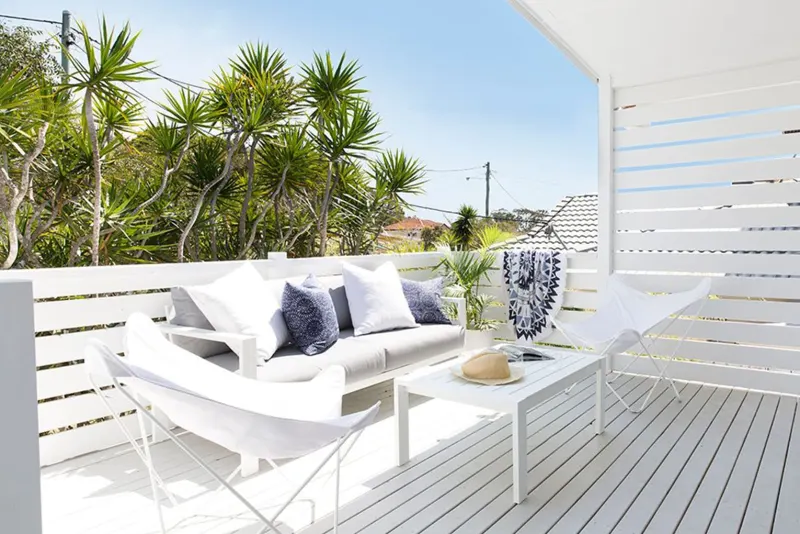
A timber privacy screen is a slatted timber panel that blocks sight lines into a yard, deck or window while still letting air through. On the Gold Coast you can usually build one up to 2.0 metres high without building approval, according to the City of Gold Coast.
Below are the Queensland height rules, the fence rules that can apply on a boundary, which timber lasts in a coastal climate, what a screen costs and how it is built. The prices here are market rates from a cost guide, checked on 3 November 2026. They are not a quote from us.
How tall can a privacy screen be without approval?
On the Gold Coast, a fence or screen up to 2.0 metres high usually needs no building approval. The City of Gold Coast says fences up to 2.0 metres generally do not need approval, with a few exceptions.
- Corner blocks: a maximum of 1.0 metre within the corner truncation, so it does not block the view of traffic.
- Waterfront blocks: a maximum of 1.2 metres within the waterway regulation line.
- Pool fencing: any height needs approval and inspection, because it has to meet the pool safety standard.
This matches the state rule. Under the Queensland Building Regulation 2021, a fence no higher than 2 metres above natural ground, and not a pool fence, is accepted development, which means no building approval. A title covenant or an overlay can still set its own limit, so check your title and talk to the council if you are unsure.
Is a privacy screen a dividing fence?
It can be, if it sits on the boundary between you and a neighbour. Queensland's Neighbourhood Disputes (Dividing Fences and Trees) Act 2011 treats a dividing fence as a shared cost, where both owners generally contribute to a "sufficient" fence (0.5 to 1.8 metres of a common material such as timber palings). If you want it taller or fancier than that, you usually pay the extra.
A screen set inside your own land, not on the boundary line, is yours alone and the dividing fence rules do not apply. Either way, it is worth talking to the neighbour first. Our timber fence cost guide covers the dividing fence process and the notice to contribute in full.
Which timber suits a privacy screen on the coast?
A durable hardwood or properly treated pine, fixed with stainless or hot-dipped galvanised screws. The Gold Coast is a tough spot for timber: salt air, strong sun and summer rain all shorten its life, and Timber Queensland notes that coastal timber can lose 3 to 5 years off its service life.
| Timber | Why it works for a screen |
|---|---|
| Merbau | Dense, durable hardwood, holds up outdoors, takes an oil finish |
| Spotted gum | Hard, durable Australian hardwood, strong grain |
| Blackbutt | Durable hardwood, lighter colour |
| Treated pine | Cheaper, use H3 for the slats above ground and H4 for posts in the ground |
Fixings matter as much as the timber. The QBCC warns that within about a kilometre of the surf, galvanised brackets and screws suited to dry indoor use will corrode, and that coastal work needs a higher grade "such as stainless steel". Near the beach, grade 316 stainless is the safe pick. Our guide to H3 vs H4 treated pine explains the treatment levels.
How much does a timber privacy screen cost?
There is no single published price for a privacy screen, so the closest guide is the price of a timber fence. On the Gold Coast, What's The Damage puts a supplied and installed timber paling fence at $78 to $185 a metre, typically about $110 (October 2026). A slatted screen in a durable hardwood sits toward the top of that range.
| Job | Price | Source |
|---|---|---|
| Timber paling fence, supply and install | $78-$185 per metre, typically $110 | What's The Damage (Gold Coast page, 2026) |
| Hardwood paling, 1.8 m, supply and install | $98-$185 per metre, typically $125 | What's The Damage (Gold Coast page, 2026) |
A freestanding feature screen with its own posts and frame can cost more per metre than a plain boundary fence, because it needs more framing and finishing. The timber species, the slat spacing and whether it is oiled all move the price. For a rough estimate on posts, rails and palings, try our free fence calculator.
How is a timber privacy screen built?
A screen is framed like a light fence. Posts are set in the ground (or bolted to a deck or slab), rails run between them, and the slats or battens fix to the rails at the spacing you want.
- Posts: treated pine H4 or a durable hardwood, set in concrete footings at the right depth for the screen height.
- Frame: top and bottom rails, and a middle rail on taller screens, to keep the slats straight.
- Slats: spaced to balance privacy and airflow. Tighter for full privacy, wider to let breeze through.
- Fixings: stainless or hot-dipped galvanised, grade 316 stainless near the surf.
Spacing is where a screen earns its keep. Close slats block the view but trap heat and wind; a small gap keeps privacy while letting the Gold Coast breeze through, which also helps the timber dry out and last longer.
How do you look after a timber screen here?
Oil it on a regular cycle and keep it clear of constant damp. A timber screen in full coastal sun fades and greys without a finish, much like a deck. A decking oil or exterior timber oil, reapplied as the finish wears, keeps the colour and slows the weathering. Our deck restoration guide covers sanding and oiling outdoor timber, which is the same idea for a screen.
What does Field Carpentry do with privacy screens?
We design and build timber privacy screens across the Gold Coast, for decks, pool areas, yards and windows, in durable hardwood or treated pine, with coastal-grade fixings. See our carpentry page for the screens, gates and outdoor timber work we do, and our deck builders page if the screen is part of a deck.
Where does this information come from?
Checked on 3 November 2026: the City of Gold Coast residential fencing page, the Queensland Building Regulation 2021, the QBCC corrosion protection guidance, and fence prices from What's The Damage (Gold Coast fencing page, October 2026). Timber durability notes are from Timber Queensland Data Sheet 20. We will check the prices again every three months.
See our carpentry work, or check what your job will cost.