 Brett Field
VJ panelling is wall or ceiling lining with V-shaped grooves cut into it at set gaps, so it looks like rows of narrow timber boards. The State Library of Queensland says many old Queensland houses were lined with tongue and groove boards, first beaded and later V-jointed, which is where the name VJ comes from.
Below is what VJ panelling is made of today, the sizes, where it works, how high a half wall usually goes, whether you can use it in a bathroom, and how it is fixed. Product facts come from the Easycraft installation guide (December 2020 edition) and the history from the State Library of Queensland, both checked on 23 November 2026. This post has no prices.
What does VJ stand for?
VJ stands for V-joint. The edge of each board is cut on an angle, so when two boards sit side by side they form a small V-shaped groove. The State Library of Queensland says Queensland houses were often lined with tongue and groove timber boards, at first beaded and later V-jointed (VJ). Timber was easy to get in Queensland, so whole walls and ceilings were done this way.
The State Library says some of these rooms were left unpainted with a shellac or oil finish. Others were painted, with skirtings, picture rails and cornices picked out in other colours. That is why VJ walls and picture rails often turn up together in an old Queenslander. Our guide to picture rails covers the rail side of that look.
Today the name covers any lining with that grooved look, whether it is real timber boards or a large sheet with the grooves machined in.
What is modern VJ panelling made of?
Most new VJ panelling is a sheet of MDF with grooves cut into the face, not loose timber boards. Easycraft, a Queensland maker, says its easyVJ100 is a 1200 mm wide, 9 mm thick moisture resistant MDF panel. Its panels come in lengths from 2400 mm to 4500 mm.
Easycraft sorts its boards by a coloured tongue on the edge, so you can tell them apart on site:
| Easycraft type | Tongue colour | Made for |
|---|---|---|
| General Purpose Interior | Green | Living rooms, bedrooms, kitchens, or covering old wall finishes |
| Wet Area Interior | Blue | Bathrooms, laundries and other high moisture rooms (not inside the shower) |
| Semi Exterior | Blue | Outdoor areas under cover, such as alfresco and patio walls, ceilings and eaves |
| Fire Rated Interior | Red | Places where fire rules for wall and ceiling linings apply |
Source: Easycraft installation guide, December 2020 edition.
Easycraft says MDF takes up and gives off moisture like solid wood, so it can grow or shrink as the air changes. That is why the gaps in the fixing steps below matter, above all in humid Gold Coast summers.
What sizes does VJ panelling come in?
A full height VJ sheet such as Easycraft's easyVJ100 is 1200 mm wide and 9 mm thick, with a groove every 100 mm. In that name, the 100 is the gap between the grooves.
| What | Size | Source |
|---|---|---|
| Sheet width (easyVJ100) | 1200 mm | Easycraft guide |
| Sheet thickness | 9 mm | Easycraft guide |
| Groove spacing (easyVJ100) | 100 mm | Easycraft profile drawings |
| Sheet lengths | 2400 mm to 4500 mm | Easycraft guide |
| Half height panels | 900 mm and 1200 mm tall | Easycraft guide |
Long sheets help on a horizontal run. Easycraft says to use one panel long enough for the whole wall where you can, so there is no butt join to open up later.
How high should VJ panelling go on a half wall?
Most half wall VJ panelling sits about 900 mm or 1200 mm high, because those are the heights the panels are made in. Easycraft's half height panels come in 900 mm and 1200 mm tall sizes, finished at the top with a dado rail.
There is no building rule for this height. It is a design choice. A few things help you pick:
- Line it up. Many people match the top to something already in the room, such as a window sill or the top of a vanity.
- Taller rooms take taller panels. In a room with a high ceiling, 1200 mm keeps the panelling from looking short.
- Finish the top edge. A dado rail covers the cut edge and gives a clean line. Our guide to what a dado rail is covers the profiles.
Easycraft says a half height panel needs a noggin behind its top edge, so the top is held firm. On an old wall with no noggin in the right spot, a carpenter adds one or fixes over the existing lining with adhesive.
Can you use VJ panelling in a bathroom?
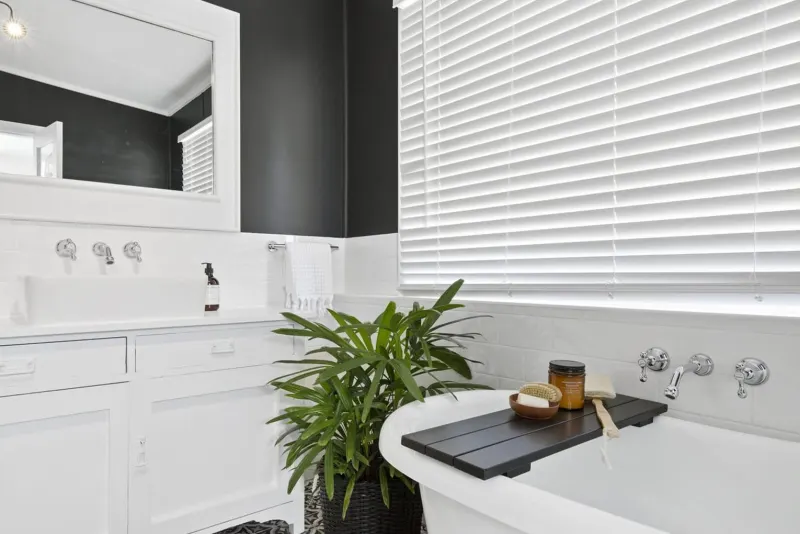
Yes, but not inside the shower and not as a splashback. Easycraft says its wet area panels are made for high moisture rooms, but they are not "Water Resistant" under the National Construction Code. So they cannot go in the shower recess, or as a splashback where the basin or bath is within 75 mm of the wall.
Easycraft lists these limits for its wall linings in bathrooms, which it says follow the NCC:
| Where in the bathroom | Easycraft's rule |
|---|---|
| Above a shower | Not lower than 1800 mm from the finished floor |
| Above a bath | At least 150 mm above the bath, for the length of the bath |
| Bath with a shower over it | No closer than 1500 mm from the wall with the fixed shower rose |
| Next to an enclosed shower | The join must be fully waterproofed and the panel protected |
| Shower recess or splashback | Not allowed |
Source: Easycraft installation guide, December 2020 edition. It points to AS 3740 for waterproofing wet areas.
In practice, tiles go in the shower and behind the vanity, and VJ panelling goes on the dry walls around them. That is a common way to get the look without risking a wet wall. In Queensland the waterproofing under the tiles is its own licensed trade. Our guide to bathroom waterproofing in Queensland explains who can do it and what it costs.
How is VJ panelling installed?
VJ sheets are glued and nailed to the wall studs, with small gaps left at the floor, ceiling and every join. These are the main steps from the Easycraft guide for timber or steel frames:
- Check the frame. Studs at no more than 600 mm apart (450 mm in busy commercial spaces). Frames must be straight and true.
- Add noggins. Where two sheets join between studs, add a noggin at 650 to 700 mm to hold the join. Our guide to noggings explains what they are.
- Let the sheets settle. Deliver them at least 48 hours before fitting and store them in the room they will go in.
- Glue first. Put flexible stud adhesive on each stud and noggin, about every 300 mm.
- Leave a gap at the floor. Sit the sheet on a 9 or 10 mm spacer so there is a gap at the bottom for movement.
- Nail it. Check it is plumb, then nail about every 200 to 300 mm, 50 mm in from the side.
- Gap the joins. Leave 1.0 to 1.5 mm at each join. Easycraft says do not "hard knock" the panels together.
- Finish. Fit skirtings and architraves, then seal the edges with a flexible paintable sealant.
On brick or block walls, Easycraft says to fix battens or furring channels to the masonry at 450 mm apart first, then fix the sheets to those.
Can VJ panelling go over an existing wall?
Yes. Easycraft says its panels can go straight onto suitable plasterboard and fibre cement wall linings, as well as onto a stud frame. For its half height panels, it says to run a 5 mm bead of flexible construction adhesive in a zig zag over the old lining, then nail into the studs.
The old wall still needs to be flat and sound. If it is bowed, cracked or damp, fix that first, or the panels will show it. In an older home, a carpenter will also check what the old lining is before cutting or drilling into it.
Can you use VJ panelling outside?
Only under cover, and only with a board made for it. Easycraft's Semi Exterior lining is a pressed hardwood board made for outdoor areas that are under a roof, such as alfresco walls, ceilings and eave linings. Its interior boards are not for outdoor use.
On the Gold Coast, salt air and summer storms are hard on any outdoor finish. Keep VJ out of the rain, paint it well, and leave the expansion gaps the maker asks for.
What does Queensland law say about who can fit it?
For work valued over $3,300, the person doing it needs a QBCC licence. The QBCC says a contractor must be licensed for building work valued over $3,300. Its carpentry licence covers fixing "internal linings, panelling and mouldings", so VJ panelling sits inside a carpenter's licence. You can read the carpentry licence scope on the QBCC site.
We fit VJ panelling, dado rails and other wall linings across the Gold Coast, from a single feature wall to a full room. Brett has more than 25 years on the tools and holds QBCC licence 15316127. See our carpentry page for the finishing work we do.
Where do these figures come from?
Checked on 23 November 2026: Easycraft, Installation Guide for wall and ceiling linings (December 2020 edition, the copy found online), and the Easycraft website; State Library of Queensland, Wallflowers: reimagining historical interiors (17 June 2025); and the QBCC pages on the carpentry licence (30 August 2021) and when you need a licence (11 August 2021). Each brand has its own rules, so follow the guide for the panel you buy. We will check these figures again every three months.
See our carpentry work, or check what your job will cost.