 Brett Field
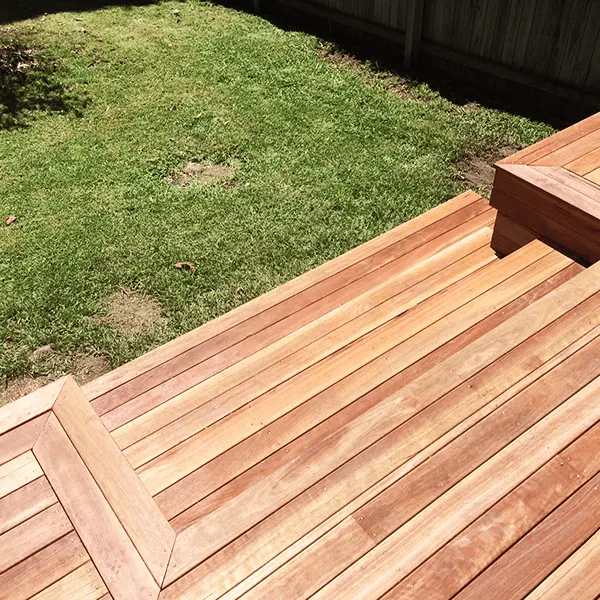
Timber fence posts in a home paling fence go no more than 2100 mm or 2400 mm apart, set by the size of the rails. Timber Queensland's data sheet on residential timber fences also says to set posts about 450 mm deep for a fence up to 1200 mm high, and 600 mm deep for a fence from 1200 mm to 1800 mm high.
Below is the spacing for each rail size, how deep and wide the holes go, what size posts to use, how many rails you need, and the Gold Coast rules that change where a fence can go. The figures come from Timber Queensland Technical Data Sheet 20 (March 2014, its current edition) and the City of Gold Coast, both checked on 23 November 2026. This is a guide for a normal paling fence up to 1800 mm high, not an engineering design.
How far apart should timber fence posts be?
No more than 2400 mm apart with the larger rails, or 2100 mm with the smaller rails. The rail is the beam that spans from post to post, so a thicker rail can span further. Timber Queensland sets the post spacing by the rail size:
| Rail timber | Rail size | Max post spacing |
|---|---|---|
| Hardwood | 75 x 38 mm | 2100 mm |
| Hardwood | 100 x 38 mm | 2400 mm |
| Cypress | 75 x 50 mm | 2100 mm |
| Cypress | 100 x 38 mm | 2400 mm |
| Treated pine | 70 x 45 mm | 2100 mm |
| Treated pine | 90 x 35 mm | 2400 mm |
Source: Timber Queensland Technical Data Sheet 20, Table 1 (March 2014).
These are maximums. Most fences end up a little closer, because the fence length is split into equal bays. A 20 m fence at 2400 mm needs 9 bays (8.3 rounded up), so each bay is about 2.2 m.
How deep should fence posts be?
About 450 mm deep for a fence up to 1200 mm high, and 600 mm deep for a fence from 1200 mm to 1800 mm high. That is Timber Queensland's figure for most soils.
| Fence height | Post depth in the ground | Hole size |
|---|---|---|
| Up to 1200 mm | About 450 mm | At least 300 mm across |
| 1200 mm to 1800 mm | About 600 mm | At least 300 mm across |
Source: Timber Queensland Technical Data Sheet 20 (March 2014).
Timber Queensland adds that for poor soil or a fence higher than 1800 mm, you should get professional advice. On the Gold Coast that matters on sandy blocks near the beach, on soft fill, and on sloping sites.
How do you set a timber fence post in the ground?
Put 100 mm of coarse gravel in the bottom of the hole so it drains, stand the post plumb, then fill around it. Timber Queensland gives two ways to fill the hole:
- Rammed earth. Backfill with soil, tamped down every 150 mm, with the top sloped away from the post to shed water.
- Concrete. A concrete footing with the top sloped away from the post. For hardwood posts, it says "no fines" concrete is recommended.
Where there is no capping, the top of each post should be sloped so rain runs off. Water sitting on end grain is one of the main ways a post starts to rot.
What size should fence posts be?
Corner and gate posts are bigger than the posts in between, because they take more load. Timber Queensland lists these sizes:
| Post | Hardwood | Cypress | Treated pine |
|---|---|---|---|
| Corner and gate posts | 100 x 100 mm or 125 mm round | 100 x 100 mm | 90 x 90 mm or 125 mm round |
| Posts in between | 100 x 75 mm or 100 mm round | 100 x 75 mm | 90 x 70 mm or 100 mm round |
Source: Timber Queensland Technical Data Sheet 20, Table 1 (March 2014).
Posts go in the ground, so Timber Queensland says any pine or hardwood with sapwood must be treated, with posts to at least H4. Rails, palings and capping need at least H3. Our guide to H3 vs H4 treated pine explains the difference.
How many rails does a paling fence need?
Two rails for a fence up to 1200 mm high, and three rails for a fence over 1200 mm up to 1800 mm. That is the Timber Queensland rule. So a 1.8 m boundary fence, the common height, takes three rails.
A few more rail rules from the same data sheet:
- Each rail should run two bays long, with the joins in the top and bottom rails staggered, so no single post carries every join.
- Palings can stick out up to 100 mm past the top or bottom rail.
- Rails can be notched into the post or fixed to its face. The notch is no deeper than 38 mm in a 100 mm post, or 35 mm in a 90 mm post.
- Each rail fixes to each post with one 10 mm cup head bolt, one No. 14 Type 17 batten screw, or two nails. All fixings are hot dipped galvanised or stainless steel.
Common palings are 100 x 15 mm or 75 x 15 mm, fixed to each rail with two galvanised or stainless nails. Palings can be spaced or butted tight. Timber Queensland notes that palings shrink and gaps open, so for full privacy they should be lapped.
Does a gate change the post spacing?
Yes. The gate opening sets where the gate posts go, and they use the heavier corner and gate post size. Timber Queensland says gates should be framed with stiles, rails and a diagonal brace the same size as the fence rails, with the brace at 30 to 60 degrees. It recommends three hinges on a gate with three rails, which means any gate over 1200 mm high.
Plan the fence from the gate out. Set the gate posts first, then split the rest of each run into equal bays no wider than the maximum for your rails.
Where should the posts sit on a boundary?
On the boundary line, unless you and your neighbour agree otherwise. Timber Queensland says to find the survey pegs before you set out a boundary fence, and that the centre line of the posts should sit on the boundary. It also says to agree with your neighbour on the type and height of fence and how the cost is shared, before you build.
Our guide to timber fence costs covers who pays for a dividing fence in Queensland.
What is different for fences on the Gold Coast?
Most home fences up to 2.0 m high do not need building approval, but some do. The City of Gold Coast says property fencing up to 2.0 metres high above the original ground level usually does not need building approval. The exceptions it lists:
| Situation | What the council says |
|---|---|
| Corner lots | Fencing within the corner cannot be over 1.0 m high, so drivers can see around it |
| Swimming pools | Pool fencing needs approval and inspection |
| Waterfront | A standard drawing limits fencing to 1.2 m high within the waterway regulation line |
| Title and estate rules | Covenants on your title or contract may limit the fence type |
| Old approvals | Conditions from the estate's first approval, such as a 50% open front fence, still apply |
Source: City of Gold Coast, Residential fencing page.
The council also says to check your boundaries, check for services with Dial Before You Dig, and consider whether an old fence may contain asbestos before you pull it down. That last one matters on older Gold Coast blocks with fibre cement fences.
Can I work out how many posts I need?
Yes. Divide the fence length by the maximum post spacing, round up to get the number of bays, then add one post. A 30 m fence at 2400 mm is 12.5 bays, so 13 bays and 14 posts, before gate posts. Our free fence calculator does this for you and also counts rails, palings and nails, using the same Timber Queensland figures.
We build and repair timber fences and gates across the Gold Coast, from a single gate to a full boundary run. Brett has more than 25 years on the tools and holds QBCC licence 15316127. See our carpentry page for the outdoor work we do.
Where do these figures come from?
Checked on 23 November 2026: Timber Queensland, Technical Data Sheet 20, Residential Timber Fences (Recommended Practice, revised March 2014, the newest edition we could find; we read the copy a timber yard hosts, so it is named, not linked), and the City of Gold Coast, Residential fencing page (no date shown). These are recommended practice for fences up to 1800 mm high on normal soil. A higher fence, a retaining wall under the fence, or poor ground needs advice for your site. We will check these figures again every three months.
See our carpentry work, or check what your job will cost.