 Brett Field
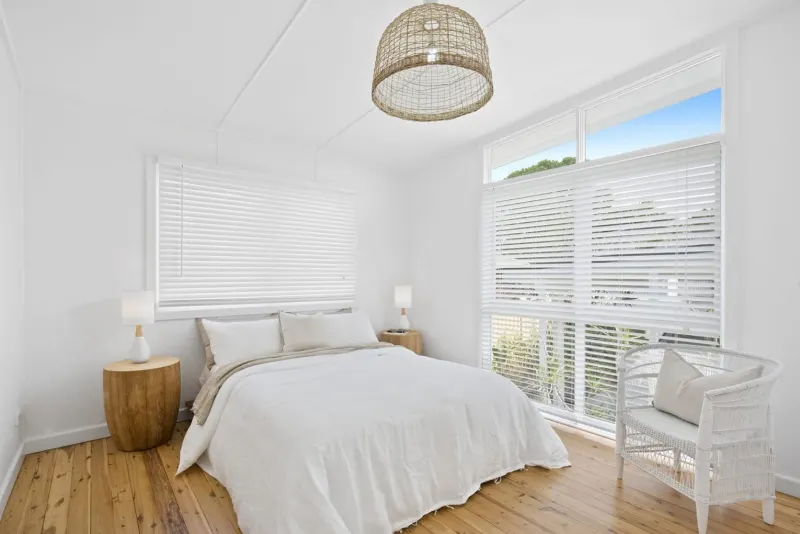
An architrave is the strip of trim around a door or window. It covers the join between the door or window frame and the wall, says The Quote Yard's Queensland trim guide. In old Greek and Roman buildings the word means something else: Britannica says it is the lowest part of the beam that sits on top of the columns.
Below are the common architrave profiles and sizes, how to match them to skirting, the no-architrave look, windows, materials, replacing old architraves and what it costs. These are market prices from cost guides, checked on 4 November 2026. They are not a quote from us.
What does an architrave do?
It hides the join where the door jamb or window frame meets the plasterboard, and gives the opening a neat border. The Quote Yard says the architrave sits on the face of the wall, set back about 5 to 8 mm from the inside edge of the frame. That small step shows a line of frame all the way round, and it should be the same on all three sides.
A door architrave is three pieces: two legs, cut square at the bottom where they meet the floor or skirting, and a head piece across the top, joined to the legs with 45 degree mitres. Because the joints sit at eye level, tight mitres are one of the first things people notice in a room.
The architrave can only be as straight as the frame behind it. The Quote Yard says the frames should be set and the gaps made even before any trim is cut. If your frame is damaged or out of square, see our guide to door frame replacement cost.
The architrave covers the gap around the door frame. Our guide to door jambs and door frames explains the parts behind it.
What are the main types of architrave?
The common shapes are square, bullnose, pencil round, splayed (bevelled), colonial and lambs tongue. Here are the sizes in one maker's Queensland range.
| Profile | What it looks like | Sizes in Corinthian's Queensland range (mm) |
|---|---|---|
| Square | Flat, with square edges | 42, 67 or 92 x 12 (pine) |
| Bullnose | A broad rounded face | 42 or 67 x 12 (pine) |
| Pencil round | Flat, with lightly rounded edges | 42 or 67 x 12 (pine or MDF); 68 or 92 x 19 (pine) |
| Splayed (bevelled) | An angled face | 42, 67 or 92 x 12; 41, 68, 92 or 140 x 19 (pine, some in MDF) |
| Half splayed | An angled edge on part of the face | 67 or 92 x 18 (MDF) |
| Colonial (three versions) | A stepped, moulded face | Colonial 67, 92 or 140 x 19 (pine); Queensland Colonial 42, 67 or 92 x 12 (pine); Australian Colonial 42 or 67 x 12 (MDF) |
| Lambs tongue | Flat, with a gentle curve | Not in this range. Bowens stocks it |
Source: Corinthian, Queensland Mouldings (2025), checked 4 November 2026. Corinthian says all its sizes are nominal. Lengths are 5.4 m.
The style rule is the same as for skirting. Bowens and The Quote Yard both put the stepped colonial shapes with traditional and heritage homes, and the flat, simple shapes with modern ones.
What size should architraves be?
Most are 65 to 90 mm wide, says The Quote Yard. In Corinthian's Queensland range the stock widths are 42, 67 or 68, and 92 mm, at 12, 18 or 19 mm thick, with a few wider boards up to 140 mm.
Wider architraves suit higher ceilings. Moulding maker Intrim said its most popular pairing was 185 mm skirting with a 90 mm architrave, and that tall ceilings can look better with larger architraves (2022).
To work out how much you need, What's The Damage allows about 5 metres of architrave for one side of a standard internal doorway. An internal door usually has trim on both sides of the wall, so allow about twice that per door (our maths).
Should architraves match the skirting boards?
Usually, yes. The Quote Yard says most skirting ranges from makers such as Intrim and Porta come with a matching architrave in the same pattern, just narrower. It calls a mismatched pair a common mistake in renovations, where the boards are bought bit by bit from different suppliers.
Matching means the same shape, not the same size. A 185 mm colonial skirting with a 90 mm colonial architrave is a matched set. A colonial skirting with a square architrave is not.
For the boards themselves, our guide to skirting board profiles covers the heights and materials.
Replacing one door in an older house? Take a short offcut of the old architrave to the supplier. Shapes with the same name can differ between makers. Corinthian alone sells three colonial profiles in Queensland.
Can you have a door without an architrave?
Yes. The no-architrave look uses a shadowline (flush) door jamb, which finishes flush with the wall so no trim is needed. Intrim made shadowline door jambs to suit 70 mm and 90 mm stud walls, in 30 mm and 40 mm thicknesses (2022). Because the jamb is sized to the wall frame, it is easiest to plan before the doors go in, not after.
Windows can skip the architrave too. Window maker A&L Windows calls this a plaster return or square set reveal: the plaster runs right to the window frame. It says this is often used in bathrooms and kitchens, where tiles run up to the window.
Do not expect it to save money. With no trim, there is nothing to hide an uneven wall or a rough plaster edge. The Quote Yard says shadowline skirting costs about the same or slightly more than boards, because the plasterboard has to be done to a higher standard. We could not find a cost guide that prices a door with no architraves, so ask for it as its own line in each quote.
What is the difference between a window reveal and an architrave?
The reveal lines the inside of the window opening, and the architrave covers the join between the reveal and the wall. A&L Windows describes a reveal as the frame or surround that finishes the inside edge of the window opening.
RMIT's building course notes say timber reveals are fitted to aluminium window frames, and the reveal width suits the wall, such as brick veneer or cladding. A&L lists three main set-ups:
- Boxed reveal. Reveals on all four sides, used when architraves go right round the window.
- No bottom reveal. Reveals on the top and sides only, for a window that sits on the floor, a bath edge or a benchtop.
- Plaster return. Like a boxed reveal, but with no architrave.
The Quote Yard adds that window architraves often stop on a sill or window board at the bottom instead of running to the floor. In Queensland, A&L offers reveals in high moisture resistant MDF, finger-jointed pine or LOSP pine, which is not pre-primed. Replacing the whole window? See our guide to window replacement cost.
For the reveal itself, its types and the size your wall needs, see our guide to what a window reveal is.
What are architraves made of?
Most are primed MDF or finger-jointed pine, with hardwood for a stained or oiled finish. Corinthian's Queensland range is mostly pine, with some MDF. Bowens says moisture-resistant (MR) MDF suits wet areas.
Each one has a weak spot. What's The Damage says MDF "swells irreversibly if it gets wet", which matters for a bathroom door or a window that leaks. For pine, Corinthian recommends an oil-based undercoat or primer to cut the risk of swelling with water-based paints. Hardwoods such as spotted gum, blackbutt and Tasmanian oak are used for clear finishes, says The Quote Yard, but cost more.
When do old architraves need replacing?
Mostly after termite or water damage, or when the doors or frames are being changed anyway. The QBCC says the Building Code of Australia requires termite protection for a few key parts of a home, and it lists architraves and skirting with door jambs, window frames and reveals. The Quote Yard notes termites feed on the timber of door frames, jambs and architraves.
The QBCC's termite page says to have a licensed pest controller inspect your home every year, or more often in high-risk areas. Get the inspection and any treatment done before the trim is replaced. Our guide to termite damage repair cost covers the order of work.
Older Queensland homes are harder to match. The Quote Yard says many Queenslanders were built with local hardwoods that may no longer be sold. What's The Damage gives three ways to match an old profile:
- a close modern match from a specialist timber supplier, the cheapest and most common answer
- a profile milled to a sample of your old trim, dearer per metre but exact
- salvaged timber from a demolition yard, which sits in between but comes in odd lengths
If your house is heritage listed, The Quote Yard says the Queensland Heritage Act 1992 applies and council may add conditions, so check before you change original trim.
How much does it cost to replace architraves?
About $10 to $44 a metre supplied and fitted, with $18 typical, on What's The Damage's Gold Coast page (November 2026). The Quote Yard's Queensland range is $10 to $22 a metre.
| Item | Price | Source |
|---|---|---|
| Architraves supplied and fitted, per metre | $10-$44 (typical $18) | What's The Damage, Gold Coast page (Nov 2026) |
| Standard architrave, supply and install, per metre | $10-$22 | The Quote Yard, Queensland (Jul 2026) |
| Carpenter, per hour | $54-$125 (typical $83) | What's The Damage, Gold Coast page (Nov 2026) |
| Carpenter, full day | $390-$880 (typical $610) | What's The Damage, Gold Coast page (Nov 2026) |
At the typical $18 a metre, the 5 metres for one side of a doorway comes to about $90. What's The Damage says one doorway is half an hour to an hour of careful work. Painting is extra: it says trim arrives primed, and filling and top coats are a separate cost. The Quote Yard puts a whole house of standard architraves at 1 to 2 days.
We fit and replace architraves across the Gold Coast, when new doors and windows go in or after termite or water damage. See our carpentry work for the doors, trim and other jobs we do.
Where do these prices come from?
Checked on 4 November 2026: What's The Damage (carpenter cost, Gold Coast page, updated November 2026, and its skirting and architrave guide, Adelaide page, November 2026), The Quote Yard (skirting board installation and replacement in Queensland, 25 July 2026, and door services, 3 June 2026), Corinthian's Queensland Mouldings range (2025), Bowens (architrave and skirting designs, 30 April 2025), Intrim's popular profiles as published by The Interiors Addict (4 February 2022), A&L Windows (what is a window reveal, undated), RMIT building notes on installing windows (undated) and Britannica (architrave, revised June 2008). Rules from the QBCC (termite protection page, March 2024). We will check the prices again every three months.
See our carpentry work, or check what your job will cost.